
The landscape of higher education admissions is undergoing a significant, data-driven evolution in the Lone Star State. With the passage of Senate Bill (SB) 1241 by the Texas Legislature, state leaders set in motion a comprehensive evaluation of the college entrance examinations used for admissions and related high-stakes decisions at Texas public universities.
To execute this critical task, the Texas Higher Education Coordinating Board (THECB) turned to the academic and psychometric expertise at Texas A&M University. The resulting study represents a landmark effort in applying scientific rigor, independent peer review, and transparency to state educational policy.
At the center of this massive undertaking was Dr. Nicola Ritter, Instructional Associate Professor at Texas A&M University, who served as a core member of the study team and helped architect the project’s technical foundation.
The Core Objective: Assessing Technical Defensibility and Policy Alignment
Under Texas Education Code Section 51.8031, the THECB is responsible for identifying which college entrance examinations—and what corresponding score thresholds—are appropriate for admissions at general academic teaching institutions in Texas.
To support the agency in fulfilling this legislative charge, the Public Policy Research Institute (PPRI) at Texas A&M University was engaged as the independent facilitator to design and administer a structured expert review of the evidence submitted by test vendors. The study evaluated three major assessments:
- The American College Test (ACT) submitted by ACT Education Corp.
- The Scholastic Aptitude Test (SAT) submitted by the College Board.
- The Classic Learning Test (CLT) submitted by Classical Learning Initiatives.
The primary goal was to systematically determine whether each assessment demonstrated sufficient technical quality, psychometric defensibility, and policy alignment for use with the diverse student population of Texas.
Dr. Nicola Ritter’s Role: Designing the Rubrics and Writing the Synthesis
A project of this scale and sensitivity requires a methodology that is legally defensible, psychometrically sound, and completely objective. Dr. Ritter’s contributions were instrumental in translating statutory language into a structured, scorable reality. Her work focused on two pivotal areas:
1. Co-Authoring the Three-Instrument Review System
To guide the evaluation, the study team designed a cohesive Three-Instrument Review System. Dr. Ritter co-authored the scoring frameworks, with a particular focus on Instrument 3: The Expert Review Rubric and Scoring Instrument.
This comprehensive rubric established the specific parameters by which the exams were evaluated. It standardized the review across multiple criteria, including:
- Psychometric validity and reliability
- Norming, equating, and representativeness
- Predictive validity for college success and gateway courses with Texas population
- Accessibility, accommodations, and fairness
- Data reporting, privacy, and governance
By establishing clear, operationalizable, and evidence-based benchmarks, this instrument ensured that every vendor submission was held to the same high standards of technical adequacy.
2. Synthesizing the Panel’s Expert Findings
After the independent panel completed their evaluations, Dr. Ritter led the crucial work of curating, analyzing, and writing the final synthesis of findings.
This task involved integrating complex quantitative ratings with detailed qualitative justifications from the reviewers, mapping out key technical strengths, and identifying unresolved implementation risks for each assessment. The resulting Expert Review Synthesis Report provided state leaders with a clear, technically grounded evidence base.
To ensure the review was completely free from bias, the study team facilitated a workflow with a distinguished panel of independent psychometricians and educational measurement experts.
These experts were drawn from major public higher education institutions across the state, bringing local understanding and national expertise to the project: experts from The University of Texas at Austin, University of North Texas, The University of Texas Rio Grande Valley, East Texas A&M University, and Texas A&M University–San Antonio.
Over several months, this panel independently evaluated thousands of pages of technical manuals, alignment studies, and validation documents submitted by the vendors.
Looking Ahead: Updating Texas Admissions Policies
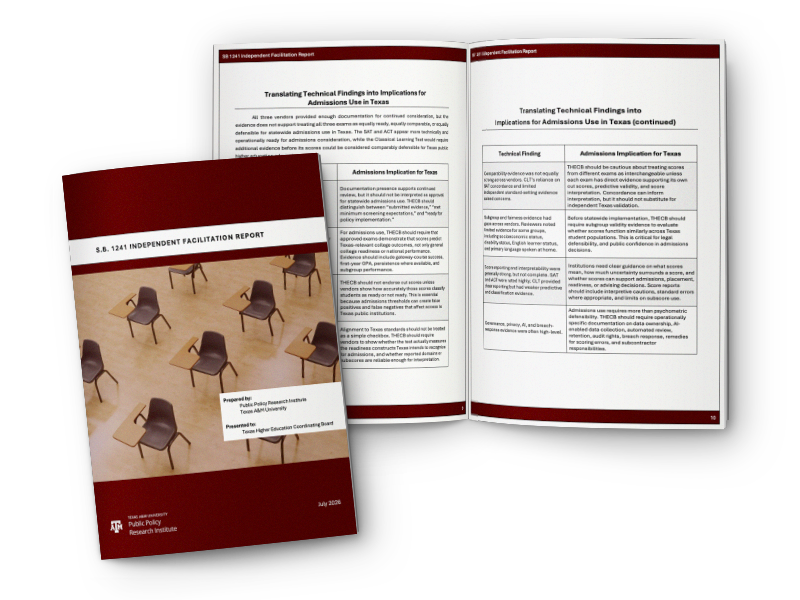
The completion of this independent facilitation study marks a major milestone for Texas public higher education. The final report was formally presented to the THECB as Agenda Item VIII-A at their quarterly meeting.
Using the structured evidence base generated by this project, THECB staff plans to initiate formal rulemaking to align the state’s Uniform Admission Policy with the study’s findings and statutory requirements. Proposed rules are expected to be presented to the Board by January 2027, and once adopted, they will officially apply beginning with the Fall 2028 admissions cycle.
Explore the Report and Draw Your Own Conclusions
To maintain the utmost objectivity and avoid any conflicts of interest, the study team has maintained a policy of strict neutrality. Rather than summarizing individual scores or declaring a single “winner,” the project team encourages educators, parents, researchers, and policymakers to review the complete technical documentation directly.
The official, publicly available Admissions Exam Study Report—including the evaluation rubrics, detailed expert panel scores, and qualitative justifications—can be accessed directly via the Texas Higher Education Coordinating Board Report Center:
Study on College Entrance Examination Scores [PDF] (Texas Education Code, Title 3, Section 51.8031)
By grounding state educational policy in independent psychometric science, Texas is ensuring that the pathways to college enrollment remain rigorous, fair, and evidence-backed for all students.
CET Service Center: Program Evaluation, Psychometric Analysis